Table of Content
That helps keep the top of your hair from flattening out, and your curls will be lighter and bouncier. Slide cutting will give you a perfectly imperfect gradation to serve as a base for your face framing layers. Use your cutting comb to direct all the hair forward, over your face and pinch out one tiny subsection at a time, each one beneath the other. Taking small subsections and a gentle approach with this cutting method will give you the most control over what you're doing as a beginner. If you see a spot that is uneven, or you want shorter layers, use the scissors to carefully trim your hair a small section at a time.

For starters, have your son or daughter stand while you sit so that you are at eye level with their hair. Use the end of a comb and measure where you want the end to be from your hairline. Use the pinking shears to create a feathering motion on the way down. Fill in your email address to receive the free “Vital Vaccine Info” printable e-book. Fill in your email address to receive the free “Dyslexia Tips” ebook from Sarah J. Brown. Fill in your email address to receive the free “Make Your Own Elderberry Syrup — with Easy Recipes!
How to Cut Your Own Hair at Home and Get Salon-Level Results
Trim the excess hair from the right segment. Cut the remainder of the section with the aid of the traveling guide. To layer cut your own hair, you’ll need to start by washing and towel drying your hair, then separating the top section into 4 parts around the crown of your head. Try cutting at an angle for a softer look, and leave your hair a little longer than you want it, since it will shrink up a bit when it dries. If you wish, you can also add layers to the sides and back of your hair. Using the second mirror frequently to check your work, lift small sections of hair and trim them with the scissors.
Repeat this process, working from to back down the center of the head. Gather a small segment of hair at the front left side to use as your first guide. Insert the segment between the forefinger and middle finger of your non-dominant hand. Slide the fingers towards the ends—pulling the segment at a 90° angle—until your fingers have arrived at your desired hair length. Trim the excess hair with a pair of sharp shears. This article has been viewed 3,846,409 times.
Many people don’t see me on the Deep Roots at Home Facebook page these days due to censorship.
If your hair is naturally curly, it would be better to cut if when it's dry. If your hair is naturally straight, it can be cut wet or dry. Don't cut at an angle, or the layers will look jagged. Make sure you hold the scissors horizontally and cut straight across. Once you've finished cutting, check all of the layers to make sure they fall where you want them to.

This creates a left side, back side, and right side. This pandemic has caused people to develop anxiety in public places. In fact, it’s also risky to go out leisurely, for you can get infected without the knowledge and may end up infecting other people. Unfortunately, people need to abide by the protocols, sacrificing their wants and needs for the common good.
#2: Wet Straight Hair, Dry Curly Hair
Face framing layers are all about opening things up and highlighting one's facial features. Keep this in mind when choosing your starting point. With most of your hair already clipped back, take a moment to notice your face shape and the features you want to highlight. I would say my face shape is square, and for best results I typically like front layers to accentuate my cheekbones.
Women can dress up pretty clothes, wear makeup, and sport new hairstyles to keep themselves happy. Pull your bangs in front of your face, twist them into one taut section, and then cut a blunt line where you want your bangs to end. It sounds terrifying at first, but the final result is gorgeous on both short and long bangs. Watch this video to see how you can get some cute fringe bangs to completely change up your look.
Step 4: Start trimming the front section of your hair.
Fasten it there with a hair elastic, then turn your head right side up. Make sure your hair is smooth against your head; any lumps or tangled parts could result in messy layering. You will have even, natural-looking layers around your head.
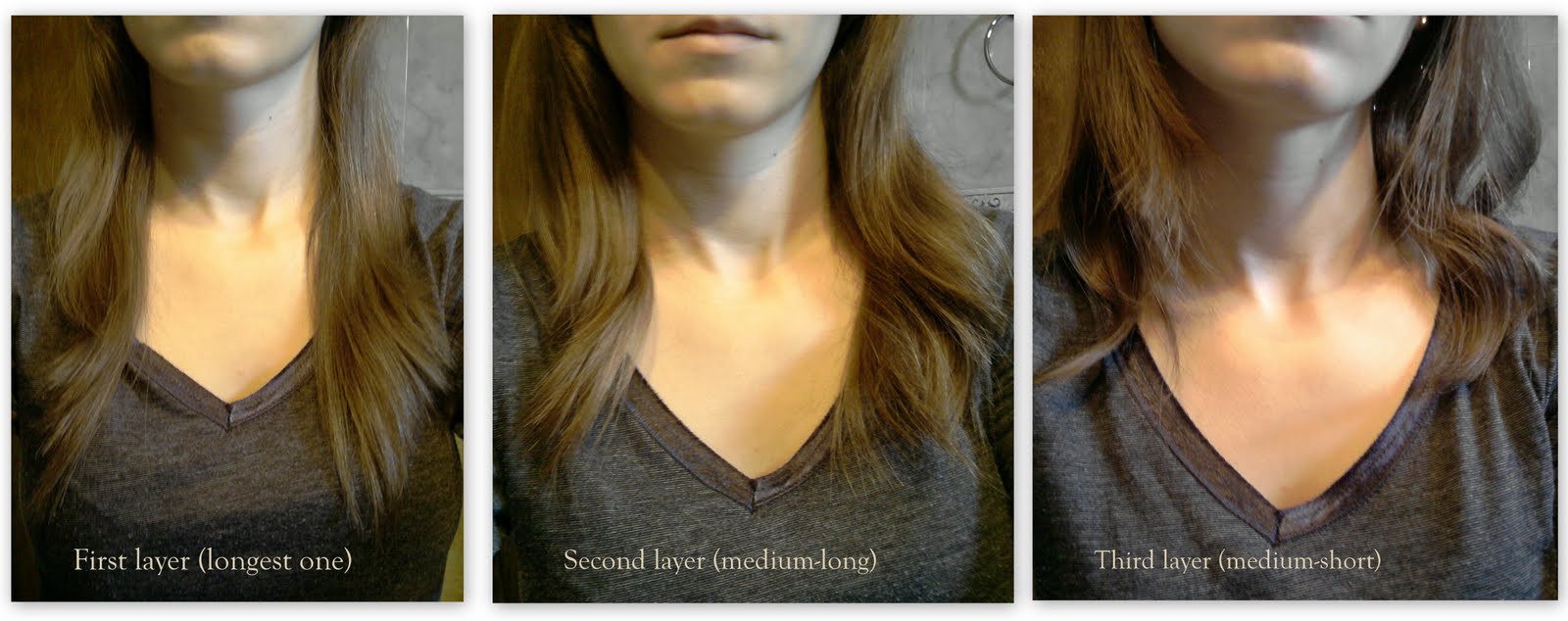
However, mastering this skill isn’t enough; you need to maintain your layered hair’s healthy appearance by practicing a good hair care regimen. Keep your layers soft and smooth by using hair growth conditioners and apply some hair growth serums for more durable and longer locks. Once you’re done with layering your hair, you have to ensure that the layers complement each other. If you’re not satisfied, you can still go shorter by further trimming the ends. Then, part your hair according to your preference or the look that you aim to sport.
If you see any extra long strands, give them a quick chop. Use two mirrors to look at the back of your hair and straighten out any uneven edges.Make sure your hair is the same length on both sides of your head. Pull strands of hair from each side forward and verify that they're the same length.
Cut the new sections while using the old sections as a guide until you’ve finished cutting the entire head of hair. Separate the bottom section of hair on the left side of the head. Comb out the entire left side using a fine tooth comb so that there aren’t any tangles, and separate the left side into an upper section and lower section. Clip the upper section up so it's out of the way for now.
Air-dry your hair, or dry it with a microfiber towel, which is gentler on your hair. Air-drying or gentle towel drying will allow your curls resume their ordinary shape and length. Cutting your hair while it's dry allows you to see immediately what the final cut is going to look like. Furthermore, curls spring up and get shorter as they dry, so you're at risk of cutting your layers too short if you chop them while they're wet. But speaking as a stylist, I can confidently say that cutting your own face-framing layers is easy-to-achieve and can give your haircut a huge boost . Keep reading for our 10-step guide on how to cut the perfect face-framing layers at home.
Plus, “if you mess up, you’ll end up needing a professional—and more than likely, you’ll have to go shorter than you initially wanted,” Thevenot says. Kamara Brown Lewis is a hairstylist at Raw Intuition salon in Los Angeles who specializes in protective hairstyles, faux locs, and curl cuts. Brown also has her own wig line that offers wigs, bundles, and clip-ins, from yaki textures to 3b/4c textures. But if you’re already about to scroll past my warnings and disclaimers and just do the dang thing yourself, then fine, I get it, and I’ve been there. Anyone with straight hair can use these foolproof methods to make sure your DIY cut is nice and even.
Despite the risks of cutting your own hair at home, a lot of people have given it a try. Luckily, there are a number of step-by-step guides out there from the pros for all lengths of hair to consult . Jenny Tran is a Hair Stylist and the Founder of JT Hair Lab by Jenny Tran based in the Dallas, Texas metro area. With over seven years of professional hair styling experience, Jenny specializes in hair coloring, haircutting, and hair extensions. JT Hair Lab is an authorized carrier of R+Co and of Milbon and is committed to using products with quality ingredients. Starting at the front of the head, insert a segment of hair surrounding the stationary guide and the stationary guide between your middle and forefinger.


No comments:
Post a Comment